Reeta R.
Swatch Digital Gift Finder
A Benchmark Review of the Digital Gift Finder
Overview
ROLE:
UX/UI Design
Timeline:
80+ hours
Tools used:
Figma
This project is a fictitious scenario, completed as a Design review for Hamburger Menus for SWATCH
Description
This case study explores the Swatch Gift Finder a smart digital assistant designed to take the stress out of shopping for the perfect watch. Instead of forcing customers to scroll through hundreds of similar-looking products, this tool acts like a friendly in-store expert that guides you through a few simple questions about who you are shopping for and what their personality is like. By translating complicated technical details into easy-to-understand lifestyle choices, the tool quickly narrows down a massive collection into a handful of personalized recommendations. Its ultimate goal is to turn a potentially overwhelming and confusing chore into a fun, quick, and confident shopping experience, ensuring that even a first-time buyer feels certain they’ve picked a gift the recipient will actually love.
Project Goal
The primary objective is to simplify the user journey. By replacing complex technical filters with a series of intuitive, lifestyle-based questions, the tool aims to reduce the cognitive load on the user, preventing them from leaving the site due to being overwhelmed by too many options.
By narrowing down a catalog of hundreds of watches to a curated selection of 3–5 highly relevant products, the project aims to drive a higher “Add to Cart” rate. The goal is to move the user from curiosity to transaction by providing choices that feel “hand-picked” and correct for the occasion.
Many gift-givers are “non-experts” who fear buying the wrong style or size. The goal of the Gift Finder is to provide a sense of expert validation. When the tool recommends a watch based on the recipient’s personality, it gives the buyer the confidence that their gift is thoughtful and appropriate.
What is Gift Finder?
A Gift Finder is a digital personal shopper that helps you pick out the perfect present without the stress of searching through an entire store. It works like a short, interactive quiz that asks you a few simple questions about who you are buying for, such as their gender, their favorite colors, or their unique personality—like whether they are sporty, artistic, or classic. Instead of overwhelming you with hundreds of random options, the tool uses your answers to filter out everything that doesn’t fit, leaving you with just a small handful of “best-matched” recommendations. It’s designed to save you time and give you the confidence that you’re choosing a gift the other person will truly love, even if you don’t know much about the products yourself.
The Challenge
Swatch carries hundreds of designs across numerous collections (Art, Sport, Irony, Big Bold, etc.). For a gift-giver, this variety often leads to “Choice Overload” or decision paralysis.
- The Problem: Users want a meaningful gift but lack the technical knowledge (case size, movement type) or the time to browse 500+ items.
- Target Audience: Holiday shoppers, birthday gift-seekers, and “non-experts” who know the recipient’s personality but not their watch preferences.
The Solution
The Gift Finder acts as a “Digital Concierge.” Instead of forcing users to use technical filters (like “34mm Stainless Steel Quartz”), it asks lifestyle-based questions to narrow down the selection.
User Flow & Experience Design:
Step 1: Segmentation (Who?): The user identifies the recipient (Woman, Man, or Unisex). This immediately cuts the catalog by 50%.
Step 2: Personality/Style (What vibe?): The quiz asks about the recipient’s style. Options often include “Sporty,” “Glamorous,” “Art-inspired,” or “Classic.”
Step 3: Visual Preference (Color/Material): Users select visual cues rather than technical specs, making the process intuitive and low-friction.
Step 4: Results: A curated “Shortlist” of few watches is presented, reducing the cognitive load.

Empathize

Define

Ideate

Prototype
01. Empathize - Exploring the User’s Needs
We recognize that choosing a gift is an act of love but it can also be a source of anxiety. Our Gift Finder is built to replace that ‘search stress’ with a sense of discovery. We aren’t just filtering watches, we are helping our users feel like the thoughtful, generous person they strive to be by making it possible for them to choose the right thing.
Users often carry three specific emotional challenges when shopping for a gift watch:
- Fear of Failure: “What if they hate it? What if it’s too big, too bright, or looks cheap?”
- Time Pressure: “I need something special, but I don’t have hours to research watch movements and strap materials.”
- Knowledge Gap: “I know my friend is cool and artistic, but I have no idea how that translates into a watch model.”
Gift finder is designed to “hold the user’s hand” through the following empathetic design choices:
- It Validates Their Style: By asking questions like “How would you describe their vibe?” the tool tells the user, “You know your friend best. Tell us about them, and we’ll handle the technical side.” This shifts the pressure off the user.
- It Simplifies the Language: Instead of asking about “Water resistance up to 3 bar” or “Quartz movements,” it uses visual cues and simple lifestyle terms. This shows empathy for the non-expert who might feel intimidated by “watch geek” talk.
- It Reduces Guilt: By presenting the Top selections, it removes the guilt of potentially missing a better option hidden on page 20. It reassures the user that they have seen the best matches.
02. Define - Establishing the User's Needs and Problems
Persona Development
From my research, I noticed specific patterns among users shopping for gifts. They were interested in finding a unique, high-quality gift but were held back by the fear of choosing the wrong style and not knowing if the watch would suit the recipient’s lifestyle, wrist size, or personal taste. I observed that participants who were not regular watch wearers themselves felt the most intimidated by technical specifications like “bioceramic” or “movement types”. To represent these challenges, I created the persona, Mark Thompson.
Mark is a thoughtful gift-giver who wants to find something special for his partner. But oftentimes he gets overwhelmed when shopping for accessories. He can’t seem to keep up with fashion trends or technical watch jargon and even if he wants to buy a cool timepiece, he doesn’t know how to match a design to his partner’s daily activities.
Mark needs a solution that simplifies the decision-making process, reduces uncertainty and provides curated recommendations based on the gifting context. A guided Gift Finder experience helps Mark move forward with confidence, transforming a stressful task into a seamless and reassuring gifting journey.
Problem Statement
Following the identification of our persona, Mark I brought together the research findings into three core problem statements to guide the design of the Swatch Gift Finder.
- Users struggle to find appropriate gifts because they are overwhelmed by too many product options and lack clear guidance based on the recipient.
- Gift-givers feel uncertain and anxious when shopping because they are unsure if their choice will feel thoughtful, personal or suitable for the recipient.
- Time-constrained users abandon or delay purchases due to lengthy browsing experiences and decision fatigue especially during last-minute gifting scenarios.
- Users lack confidence in their final selection because there is little reassurance that the chosen gift aligns with the recipient’s expectations.
- Generic browsing experiences fail to support gifting intent, forcing users to do the mental work of filtering, comparing and validating gift choices on their own.
03. Ideate - Translating Problems into Solutions
Following the definition of our user problems, the ideation phase focused on transforming those pain points into a functional, interactive experience. The goal was to build a logic flow that mimics a conversation with a professional stylist.
The Strategy: Question – Attribute Mapping
To solve the Technical Intimidation problem, I mapped simple lifestyle questions to complex product attributes:
- User Question: “Who are you shopping for?” – Logic: Filters by gender-based segments (Man, Woman, Unisex).
- User Question: “How would you describe their style?” – Logic: Maps personality traits to specific Swatch collections (Art – Inspired, Fun, Sporty, Sophisticated).
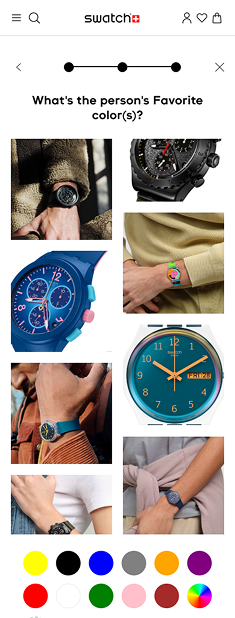
- User Question: “What colors do they wear most?” – Logic: Filters by dial and strap colors.
Key Ideation Features
- Step-by-Step Navigation: Instead of a long form, I designed a multi-step progress bar (Step 1 to Step 3) to maintain momentum and reduce cognitive load.
- Visual-Heavy Options: To bridge the Style-Gap, I utilized high-resolution imagery for each answer choice, allowing users like Mark to “feel” the vibe rather than read it.
- The Recommendation: I designed a results page that prioritizes a Top Pick followed by 4–8 alternatives to ensure the user feels they have a curated selection without being overwhelmed.
Wireframing the Flow
The initial sketches focused on a Mobile-First approach, ensuring that the touch targets for the quiz were large and intuitive.
- Progressive Disclosure: Each question only appears after the previous one is answered to keep the user focused.
- Instant Gratification: As users select options, the underlying system begins narrowing the count of “Matching Watches” shown at the screen.
04. Final Design & Prototype – The Polished Experience!
In the final phase, the conceptual ideas were transformed into a high-fidelity, interactive interface that aligns with Swatch’s vibrant brand identity. The goal was to ensure the transition from “quiz-taker” to “buyer” was seamless and visually engaging.
High-Fidelity UI Features
- Minimalist Interactive UI: The design utilizes a clean, white background to make the colorful watch imagery pop, ensuring that the user’s focus remains on the product aesthetics.
- Progressive Interaction (Step-by-Step): Each stage of the quiz—starting from “Who are you shopping for?” – is isolated to a single screen to prevent visual clutter.
- Segmented Choices: Users are presented with clear, highlighted buttons for “Woman,” “Man,” and “Unisex” to immediately narrow the catalog.
- Real-Time Visual Feedback: As users progress, the interface displays high-resolution images of popular models like “SWATCH NEON” and “HOW MAJESTIC” to provide immediate visual inspiration.
The Final User Journey
- Entry: Users land on the Gift Finder and are greeted with a simple, low-pressure question: “Who are you shopping for?”.
- Discovery: Through a series of few steps, the tool captures style preferences and personality traits without using technical jargon.
- Result: The final screen presents a curated selection of watches that match the user’s specific inputs, effectively acting as a “Shortlist”.
- Conversion: Each recommendation includes a direct link to the product page, allowing users to move from discovery to checkout in just a few clicks.
Outcomes and Impact
- Empowered Decision Making: By reducing the catalog to a few personalized choices, the tool eliminates the “Fear of Failure” for gift-givers.
- Brand Consistency: The playful, fast-paced nature of the quiz reinforces Swatch’s image as an accessible and innovative watchmaker.
- Improved UX Metrics: The simplified flow reduces bounce rates and increases the time spent engaging with the brand’s diverse collections.
Hi-Fidelity Designs on Desktop

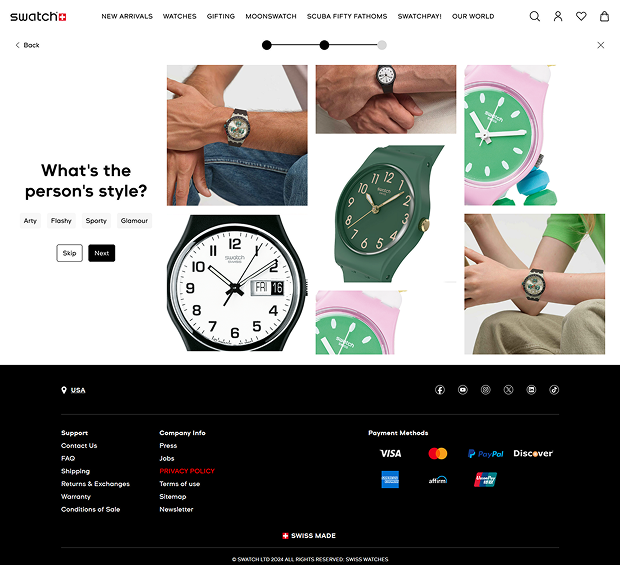


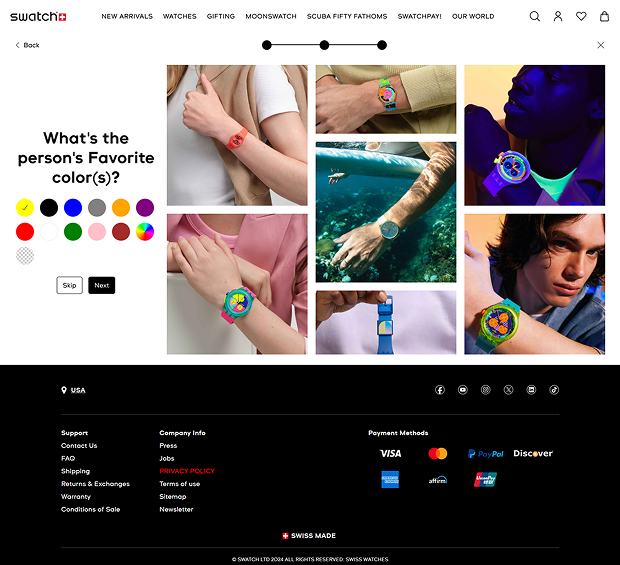
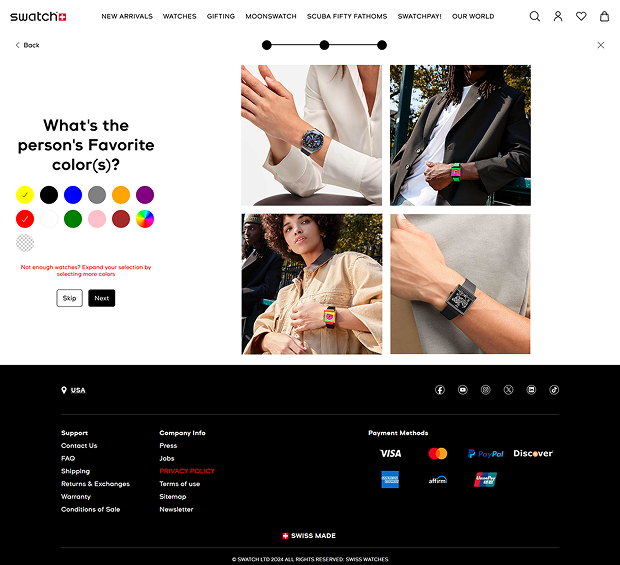
Hi-Fidelity Designs on Mobile

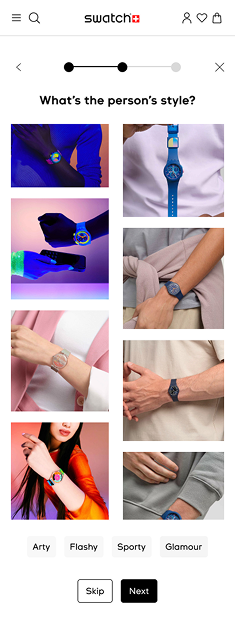

The Swatch Gift Finder is a prime example of Customer-Centric Design. It recognizes that a watch is an emotional purchase. By translating technical specs into lifestyle questions, Swatch removes the barrier to entry for casual shoppers, positioning itself as a helpful, accessible brand.

Disclaimer!
These designs are shared purely to showcase my work and experience. They don’t suggest ownership or any present partnership with the brands or companies featured.